
State compliance · California
California subcontractor license verification: what GCs must check before work starts
California auto-suspends contractor licenses the moment a bond or workers' comp policy lapses — no warning, no grace period. If your sub is suspended when something goes wrong, the exposure is yours.
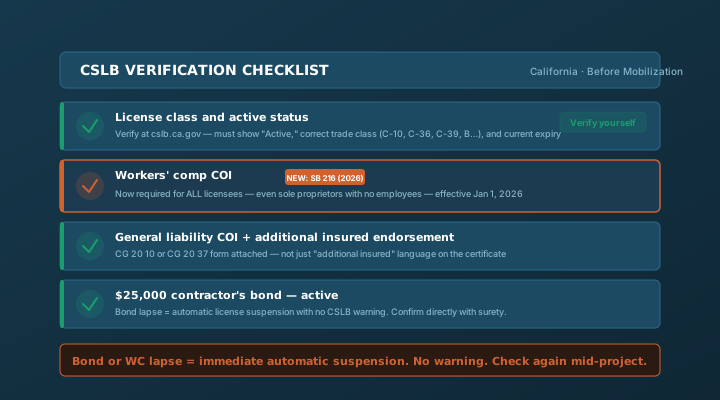
California has the most aggressively enforced contractor licensing system in the country. The Contractors State License Board (CSLB) licenses over 290,000 contractors and actively investigates unlicensed activity. When a licensed contractor's bond or workers' compensation policy lapses, the CSLB automatically suspends their license — immediately, without notice.
For general contractors in California, this creates a problem that goes beyond compliance paperwork. A sub who was licensed when you hired them may not be licensed today. And California's unlicensed contractor statute has consequences that reach further up the chain than most GCs realize.
What California law requires GCs to verify
Under California Business and Professions Code §7031, any contractor who performs work without a valid license cannot recover compensation for that work in court — and neither can anyone who hired them knowing they were unlicensed. The statute applies to sub-tier contractors too.
That last part matters. If a GC hires an unlicensed sub and something goes wrong — a dispute over payment, a defect claim, an injury — the unlicensed contractor's involvement can be used against the GC. Courts have applied §7031 to void contracts, bar recovery, and expose the hiring party to disgorgement of amounts already paid.
Before a California sub mobilizes, a GC should verify four things:
- License class and active status. Each trade requires a specific CSLB license class — C-10 for electrical, C-36 for plumbing, C-39 for roofing, B for general building. Verify the class is correct for the scope and that the license shows "Active" — not Suspended, Expired, or Canceled.
- Bond on file. California licensees must maintain a $25,000 contractor's bond. If it lapses, the CSLB suspends the license. The bond amount doubles to $50,000 for contractors with a history of non-compliance.
- Workers' compensation coverage. Required for any licensee with employees — and as of January 1, 2026, required for all licensees regardless of whether they have employees (see SB 216 below).
- License expiration date. CSLB licenses renew every two years. An expired license is not an active license.
All of this is verifiable through the CSLB's free online license check at cslb.ca.gov. The check takes about 30 seconds. The problem is that most GC teams check once at onboarding and never look again.
The automatic suspension trap
This is the part most GC teams do not know about.
In California, a contractor's license is automatically suspended the moment their surety bond is canceled or their workers' comp policy lapses. The CSLB does not send a warning. The contractor does not get a grace period. The license goes from Active to Suspended the day coverage drops.
For a GC managing multiple active subs on a California project, this means a sub who was fully licensed at the start of a six-month job may be suspended by month three — and you would not know unless you check again.
Work performed during a period of suspension is work performed without a valid license. The CSLB can cite both the unlicensed sub and the GC who authorized the work. On top of that, the §7031 exposure attaches to any work performed during the suspended period.
SB 216: the new workers' comp rule that changes what you need to collect
Effective January 1, 2026, California SB 216 requires every CSLB licensee to maintain workers' compensation insurance — even sole proprietors with no employees.
Before SB 216, a solo operator or single-officer LLC could hold a valid California contractor's license without carrying WC. They were legally exempt if they had no employees. That exemption is now gone for most license classes.
What this means for GC compliance teams: a certificate of insurance showing workers' comp is now a required document for virtually every California subcontractor — not just the ones with employees on payroll. If your sub is a one-person electrical contractor and they cannot produce a WC certificate, their license may already be in jeopardy.
A sub who cannot show you a current WC certificate is now a sub who may be operating on a suspended license. Both problems land on your job site at the same time.
What to collect from every California subcontractor
For any California sub, before work starts:
- CSLB license number and class. Verify it yourself at cslb.ca.gov — do not rely on a copy the sub hands you. Check active status, correct trade class, and expiration date.
- Certificate of Insurance showing workers' comp coverage. Required under SB 216 for virtually all licensees as of January 2026. The policy must be active and the dates must cover the work period.
- General liability COI with additional insured endorsement. Your company named as additional insured, with the CG 20 10 or CG 20 37 endorsement attached — not just a certificate that says "additional insured" without the form.
- Proof of bond. California's $25,000 contractor's bond is a condition of licensure. A bond certificate or confirmation from the surety that the bond is active covers this.
- W-9. Required before any payment processes and a basic confirmation of the sub's business identity.
None of this is one-time collection. For projects running longer than a few months, expiration dates on the WC policy, the bond, and the license itself all need to be tracked and renewed mid-project.
How to verify without adding to your workload
A solo check on the CSLB portal takes 30 seconds. Doing that for 20 active subs, every 60 days, across three active projects — that is real time that falls on someone who already has a full job.
Send The Proof handles the document-collection side automatically. Each sub gets a secure upload link — no account required. They submit their WC certificate, their COI, their bond certificate. Expiration dates go into the system. Thirty days before anything lapses, the sub gets an automatic renewal request. You see active, expiring, or blocked status for every vendor on one dashboard.
The CSLB status check is still a manual step — you run it yourself at onboarding and again if a renewal comes in late. But when the document side is automated, the license check is the only thing left on your plate.
The first five vendors are free. The paid plan is $29.95 a month.
Start free — no credit card required.
Related: how to spot a fake or altered certificate of insurance, the compliance status dashboard, and subcontractor onboarding software for general contractors.