
Risk management
Workers' comp audit: what happens when you can't produce a subcontractor's COI
The auditor does not just look at your W-2 payroll. They look at every dollar paid to subcontractors — and they ask for proof that each one carried their own coverage.
Every general contractor with workers' compensation coverage goes through an annual premium audit. Your insurer sends someone to verify that the premium you paid at the start of the policy year matches the payroll you actually ran. Underpaid? You owe the difference. Overpaid? You get a credit.
Simple enough. But most GC teams do not realize that subcontractor payments feed directly into this calculation — and that missing a single COI can turn a routine audit into a five-figure surprise.
How workers' comp premium audits actually work for general contractors
At audit time, the auditor pulls your payroll records, your 1099s, and your accounts payable. They total up every dollar paid to subcontractors. Then they ask one question for each sub: did this company carry their own workers' comp coverage during the period they worked for you?
If yes, the sub's payroll stays off your books. Their insurer absorbs any claim their workers file.
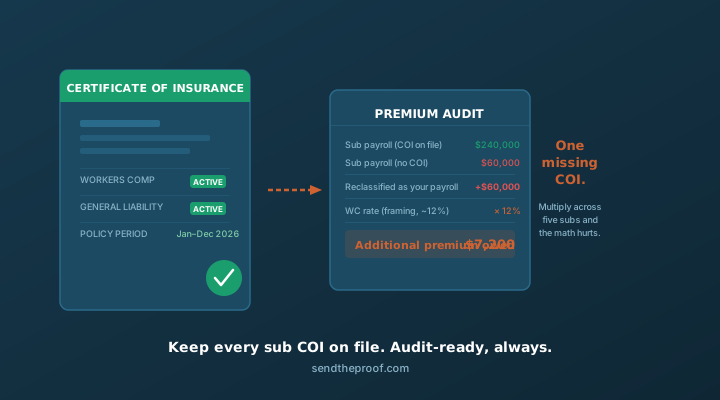
If you cannot produce a valid COI for that sub, the auditor classifies their payroll as yours. That dollar amount gets added to your premium calculation — at the class code rate for whatever work that sub performed. Framing, electrical, roofing. These are not cheap class codes.
What a missing COI actually costs you at audit time
Here is a concrete example.
You paid a framing crew $60,000 for work on a residential project. They are a legitimate LLC — not an employee. But their COI expired six weeks into the job and no one chased a renewal. By audit time, the certificate you have on file shows an expired policy date. The auditor cannot verify active coverage for the full work period.
That $60,000 gets added to your payroll. Framing classifications typically run 10–15% in workers' comp rates. On $60,000, that is $6,000 to $9,000 in additional premium — for one subcontractor.
Now scale that across a typical project roster. Three subs whose policies lapsed mid-project. Two subs whose COIs you never collected at all. One sub who gave you a certificate that expired before they mobilized. That is easily $20,000 to $60,000 in audit adjustments on a mid-size commercial job. Some GC teams have seen six-figure premium bills from a single audit cycle.
What a valid COI must show to satisfy the auditor
The auditor is not looking for a file full of PDFs. They are looking for specific evidence of active coverage. A certificate of insurance that passes audit review must show:
- Workers' compensation coverage listed as active. Either on the ACORD 25 or a separate workers' comp certificate. General liability alone does not satisfy this requirement.
- Policy dates that cover the period the sub worked. A certificate valid from January to June does not cover work performed in August. The dates must match the actual work period.
- The subcontractor as the named insured. Not a related entity, not their parent company. The sub performing the work.
- A policy number that can be verified. Auditors check. Invalid or unverifiable policy numbers fail.
An expired certificate does not pass. A certificate showing only general liability does not pass. A certificate with dates that do not cover the work period does not pass.
The timing trap most GC teams miss
The audit covers the entire prior policy year — typically 12 months of subcontractor activity. A COI that is valid today is not retroactive proof of coverage from eight months ago.
This is the part that bites teams who collect COIs at project start and then never update them. A policy that was valid in January may have lapsed by April. If the sub continued working through July and the only certificate you have is from January with an expired policy date, you have a documentation gap that the auditor will flag.
The only clean answer is a timestamped record showing the sub had active, uninterrupted coverage for the period they performed work on your jobs. That means collecting renewal certificates when policies expire mid-project — not just at onboarding.
How to make workers' comp audit day a 30-second answer
GC teams that sail through premium audits without surprise adjustments do three things consistently.
- Collect the COI before work starts, not after. No certificate, no mobilization. This is the single most important gate — a sub on site without a valid COI is already an audit problem.
- Track expiration dates and require renewals mid-project. A policy that expires six weeks into a three-month job needs to be renewed. If the sub does not send a renewal certificate, work stops.
- Keep a timestamped record of every certificate. Date received, dates it covers, policy number. When the auditor asks, you pull the record — you do not dig through email.
Send The Proof automates all three steps. Each sub gets a secure upload link — no account required. When the COI comes in, the expiration date goes into the system automatically. Thirty days before it lapses, the sub gets a renewal request. If they do not respond, follow-up reminders go out. You see active, expiring, or blocked status for every vendor in real time.
When the auditor asks for documentation, you pull the audit trail — a clean, exportable record of every COI submitted, every expiration date, and every renewal. That is the difference between a 30-second answer and a $40,000 surprise.
The first five vendors are free. The paid plan is $29.95 a month.
Start free — no credit card required.
Related: the audit trail feature, COI tracking software for general contractors, and the real financial exposure of a lapsed subcontractor COI.