
State compliance · Florida
Florida subcontractor workers' comp: what every GC must collect before work starts
Florida law makes you the statutory employer for any uninsured sub's injury claim. A valid COI or an active exemption certificate is not optional — it is your only protection.
Florida is one of the most aggressively enforced workers' compensation states in the country for construction. It does not have Texas's opt-out system. It does not give GCs a damage cap. What it has is a statutory employer rule that puts you directly on the hook when a subcontractor's worker gets hurt and there is no coverage behind them.
The rule applies whether the sub forgot to renew their policy, never had one, or handed you an exemption certificate that expired months ago without telling you. If you cannot prove coverage was in place when the injury happened, the financial exposure lands on you.
What Florida's statutory employer rule actually means
Under Florida Statute 440.10, general contractors are considered the statutory employer for the employees of any subcontractor who fails to secure workers' compensation coverage. If a sub's worker gets injured on your job site and the sub has no active coverage, you are responsible for paying the injured worker's benefits.
This is not a theoretical liability. The Florida Department of Financial Services (DFS) enforces it aggressively. Stop-work orders are issued on job sites where coverage cannot be confirmed. Audits happen. Penalties for non-compliance on a single job can reach hundreds of thousands of dollars.
The only way to break the statutory employer chain is to have documentation proving the sub carried their own coverage — or held a valid exemption — for the period they worked on your project.
Florida's construction exemption system — and why it complicates your job
Here is what makes Florida different from most states: certain construction workers can legally opt out of workers' comp coverage by filing an exemption with the DFS.
Corporate officers of construction companies can apply for an officer exemption under F.S. 440.05. Sole proprietors and partners in the construction industry are generally excluded from mandatory coverage under F.S. 440.02. When a sub holds a valid exemption, they do not need to carry a workers' comp policy — the exemption is their documentation.
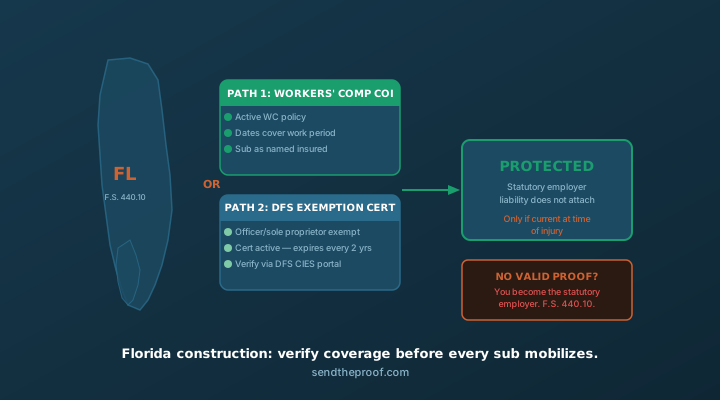
For GCs, this creates two valid documentation paths:
- A workers' comp certificate of insurance (COI) — showing an active policy, dates that cover the work period, and the sub as the named insured.
- A current DFS exemption certificate — showing the specific officer or sole proprietor is exempt, with an active status and expiration date that covers the work period.
Both protect you. But both expire. And both can be revoked. A sub who had a valid exemption last year may not have one today.
The exemption trap GC teams fall into
Florida exemption certificates expire every two years. When they lapse, the officer or sole proprietor is no longer exempt — they are required to carry coverage like any other employer, even if they have no employees.
Most GC teams do not track exemption certificate expiration dates. They collect the certificate at project start, file it, and forget it. Six months later, the certificate has expired. The sub never renewed it. Work continues. Then something happens.
At that point, the sub has no active coverage and no active exemption. The DFS looks at who hired them. That is you. Statutory employer liability attaches regardless of whether the lapse was intentional or administrative.
The same trap applies to COIs. A policy that was active in January does not automatically cover work done in August. Florida construction projects can run for years. Every sub on a multi-phase job needs to have their coverage — or exemption — verified continuously, not just at mobilization.
What to collect from every Florida subcontractor before work starts
For every sub on a Florida construction project, you need one of the following. Dates must cover the actual work period.
- Certificate of Insurance (ACORD 25) showing active workers' comp coverage, the sub as named insured, and policy effective/expiration dates that span the period they will work. Verify the policy is active through the DFS's online portal — do not rely on the certificate alone.
- DFS Officer Exemption Certificate with a current status and expiration date. Look up the sub's exemption at the DFS CIES (Construction Industry Exemption System) portal before work starts — certificates can be revoked or allow-listed for specific companies only.
- Florida contractor license verification via the DBPR (Department of Business and Professional Regulation). Licensed trades — electrical, plumbing, roofing, mechanical — must hold an active state license. A lapsed or suspended license is its own compliance problem, separate from the WC issue.
- W-9 before any payment processes.
None of this is one-time collection. For a project running six months or longer, you need to verify that coverage and exemptions remain active — mid-project — before you have a gap in the record.
How to keep a clean compliance record across every Florida sub
The GC teams that avoid DFS stop-work orders and statutory employer claims share one habit: they treat subcontractor compliance as a continuous process, not a one-time checklist at project start.
That means tracking expiration dates — not just for COIs, but for exemption certificates and contractor licenses. It means sending renewal requests before documents lapse. And it means keeping a timestamped record so that if something goes wrong on month seven of a nine-month project, you can show exactly what was on file and when.
Send The Proof handles this for each sub automatically. Add a vendor, send a secure upload link — no account required for the sub or their agent. The system tracks every expiration date and sends renewal requests 30 days out. You see compliant, expiring, or blocked status across your full roster in real time. When the DFS or your insurer asks what you had on file, you pull the audit trail.
The first five vendors are free. The paid plan is $29.95 a month. A single DFS stop-work order can shut down a Florida job site for days while documentation is assembled — and fines for non-compliance start at $1,000 per day per employee found without coverage.
Start free — no credit card required.
Related: how missing COIs cost GCs at workers' comp audit time, COI tracking software for general contractors, and the subcontractor compliance checklist.